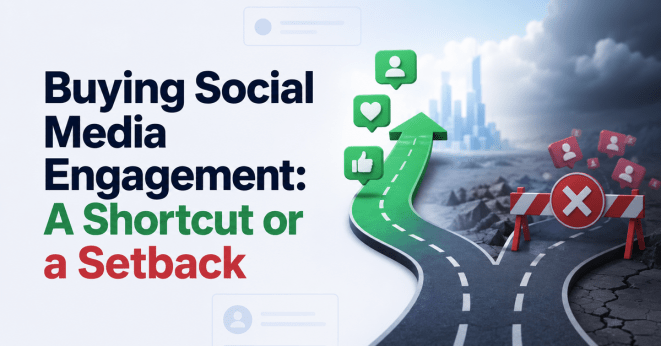
These days, brands are eager to grow their online presence quickly, and harbor an understanding for short-cuts. Buying engagement on social media is quick and easy. But, it gets brands asking if it’s the real thing, and if it will last. In this article, we will elaborate on buying engagement in detail – potential risks and rewards. We will also look at the ethical elements of this, impacts on brand reputation, and stimulation of true engagement. We hope to give the audience more than just an overview of the metrics.
With all of this as a backdrop, we hope to give you a badge that legitimizes your presence on the internet. This journey will be long and tedious, but we guarantee you will learn how to successfully navigate the digital frontier.
What is Buying Social Media Engagement?
If you choose to buy social media engagement, you’re looking at buying likes, followers, comments and shares for your social media posts. Quick, simple visibility and credibility is promised with these services. Some think they’re providing an illusion of real audience interaction. Because of the nature of this service, these likes, followers and comments are most likely coming from bots and fake accounts. Socialsanta to be great for businesses to appear more important, and gain organic followers quick. You should also consider the negative aspects of this.
Those who are more inclined to this service are most likely money hungry people who want to gain a quick following, and want an even faster way to gain popularity. However, what people don’t understand is that isn’t the best in the long run. It’s about being honest and authentic because that will bring real engagement, and in turn, a real following.
Though this service offers quick reach and visibility, long term damage to your account is almost guaranteed. Quality over quantity is the best practice to gain a real audience to engage with.
The Ethics of Paying for Social Media Engagement
The ethics of buying social media engagement is more complicated than it seems. Assuming that fake popularity is better than no popularity at all speaks volumes about our culture. It begs the most important question of this digital age: how do we define true connection in an environment where everything is fake? There are certain values and principles that are challenged when social media engagement is bought. When someone decides to buy social media engagement, are they willing to sacrifice their reputation and credibility to inflate their social media following? social media engagement buying is a communication dilemma of today’s society: do we communicate with fake social media engagement to keep up with the competition, or do we keep it honest and leave social media engagement buying to no end?
Despite the many imperfections of social media, buying social media engagement has given us something to think about: how can we conduct ourselves more honestly online? This digital age can lose its integrity and focus on authenticity. Transparent communication online can still pay off socially more than pretending to be fake and buying social media engagement.
The Impact on Brand Reputation
The impact of faking social media engagement on your brand’s reputation comes down to some risks. Faking numbers means you’ll be buying fans, and getting people to like or follow you won’t get you actual customers. Fans who follow you because you paid for them means real customers will see that you’re popular but fake. The trust you’re building with your real customers will go down, and your brand will get a bad reputation. Real customers can see through fake engagement, and your brand will suffier for it by not investing in building a relationship. Faked social media engagement may help in the short term, but building a real relationship with your customers is the best way to increase your sales and help your brand grow.
Building trust with your customers can grow your reputation and your profits. Brands that provide good customers with honest interactions will be remembered and liked by more customers. Building a good reputation is about creating real relationships. Trust from customers is the foundation of a good reputation, so fake social media engagement is a bad way to build your brand.
The Value of Social Media Interaction
Social media, though seemingly impersonal, contributes to personal and professional relationship development through forming genuine connections with customers. Developing and maintaining relationships relies not on having the most followers, but rather it relies on the true impact of your relationships. In addition to improved visibility, the true impact of relationships results in the development of a communal and supportive user base. Increased engagement expands the reach of your relationship and message. This results in a snowball effect in which your relationship and message becomes highly visible.
There are other benefits to engaging with social media that one may not expect. Engagement, adeptly used, solidifies Trust and Credibility as an authentic and valuable social media user. Engaging with social media shows the Audience and customers that you value the relationship enough to invest time in the relationship. It demonstrates the value of social media relationships. Many users perceive the value of relationship investing social media users. They also develop a genuine relationship with the user and support the user and the resources the user develops by becoming avid users of the social media resources as well.
Long-Term Effects on Engagement
Buying social media engagement may give you a fun little boost to your follower count, but it doesn’t take long for brands and potential customers to figure out what you did and for those dwell numbers you purchased to become dwell numbers no one trusts. Eventually, real followers will get tired of your content if they believe it to be inauthentic. Moreover, a reliance on social media engagement numbers purchased as a shortcut to success means that you will never build a communication and relationship path with your audience. An audience and customer base take time to develop, while engagement and relationship take time to develop.
In the end, investments in purchasing social media engagements are just a waste of money. In the long run, real customers will shine the true worth of your organization and brand. Loyal customers will support your organization if you place customer value first.
How To Naturally Get Followers To Participate On Your Social Media
In order to maximize the quality of your social media, interaction with customers should beOrganic. This means that the content that you are posting should be relevant to your customer’s interests. High quality content is the first step to positive engagement with your customers and posting content that will generate positive discussions should be the end result. Regular engagement with comments and questions that support your customers should be practiced to show the personality of your brand. Connections with customers can be made with the use of stories on your social medias. Strengthen your social media content with positive meaningful discussions, and followers that will remain dedicated to your brand.
Whether it is on social medias, engagement means positive reactions. You have to know your customer’s best to determine when the best time to make those positive reactions. A high level of interactivity means content is so loved that it is considered a must read each time a post is made. Organic social media strategies grow a business company relationship with your customers.
Conclusion
There are many shortcuts in social media today that we could easily adapt to gain more engagement. However, using “organic” methods of social media will help you gain an authentic audience that values your content. Social media is more than just follower counts. It also describes the interactions and the content posted. If you focus on creating valuable content for your social page, your audience will continue to grow. As your audience grows, so will your business.




From Portfolio Exposure to Client Discovery: An Instagram Impressions Strategy for Freelance Designers
A freelance designer can collect thousands of Instagram impressions and still hear nothing from the clients they want. The number confirms that content appeared on screens; it does not confirm that viewers understood the designer’s specialty, trusted the process, or had a relevant project. For a new portfolio, exposure is useful only when it helps the right people discover evidence they can evaluate. That requires a deliberate path from visual attention to professional context.
Choose the Work You Want the Profile to Invite
Many early portfolios try to look versatile by displaying every logo, poster, illustration, and interface the designer has made. The result can feel active but directionless. Before pursuing more Instagram impressions, a freelancer should identify the work they want next. A packaging designer seeking independent food brands needs different proof from a product designer targeting SaaS teams.
This focus does not require rejecting other skills. It gives the Instagram profile a recognizable center. Three or four related case studies can establish a clearer proposition than twenty disconnected images. The bio should name the service, typical client, and working region or availability. Contact information must be easy to find without forcing a prospective client to decode a link hub.
Designers can also define a discovery statement: “A founder who sees this post should understand that I turn complex product features into approachable onboarding.” That statement guides creative choices and provides a better test than “I want more reach.” It specifies who should notice and what they should learn.
Turn Finished Images Into Credibility Evidence
A polished Instagram mockup shows taste, but clients often hire the thinking behind it. Instagram carousels and Reels can reveal the brief, constraints, rejected directions, typography choices, accessibility decisions, and final application. Even a self-initiated project becomes more credible when the designer explains the imagined customer and trade-offs.
Instagram case-study storytelling should remain concise. Open with the business problem, show a meaningful decision, and end with the result or lesson. Avoid presenting an invented project as paid client work. Clear labels such as “concept project” protect trust while still demonstrating skill. If real performance data is unavailable, describe the design outcome rather than fabricating commercial impact.
Process content needs boundaries. Freelancers should remove confidential details and obtain permission before sharing client materials. Screenshots can expose names, budgets, or internal discussions. A carefully redacted Instagram post is preferable to a dramatic behind-the-scenes reveal that weakens professional confidence.
Build Several Doors Into the Portfolio
Not every prospect discovers a designer through the same post. A marketing manager may find a packaging Reel, browse the grid, open a relevant highlight, and visit the website days later. A founder might save a pricing explainer before sending it to a colleague. Instagram should offer several coherent routes without making every post a direct pitch.
Use highlights for services, selected work, process, client questions, and contact details. Pin posts that quickly explain the specialty and strongest case studies. Captions should include enough context for viewers who do not already know the project. Alt text, captions on video, and readable type make the portfolio more accessible as well as easier to understand.
The external portfolio should continue the same promise. If Instagram emphasizes hospitality branding, the linked page should not open with unrelated app illustrations. Mobile speed, clear navigation, project roles, and a simple inquiry route affect discovery after the impression has already been counted.
Keep Supplementary Impressions in Perspective
Freelance designers sometimes consider purchasing Instagram impressions or related visibility to increase the displayed activity around selected portfolio content. A provider may offer a defined quantity or delivery window, but that exposure does not show that viewers are qualified clients, understood the case study, or intend to commission work. When a designer wants supplementary display for one packaging case study or interface walkthrough, Planyourgram makes it possible to choose an impression amount suited to that portfolio asset and record it separately. It belongs in reporting as a separate distribution input.
Purchased activity cannot guarantee organic Instagram reach, inquiries, contracts, or professional reputation. It may also complicate engagement-rate comparisons if blended with native results. Designers should record the amount, timing, post, and intended purpose, then keep those figures distinct from advertising, collaborator shares, and organic discovery.
Read Impressions Alongside Qualified Behavior
Instagram impressions and reach are not identical. Reach estimates how many accounts saw content; impressions include repeated displays. A widening gap may indicate that people encountered the post more than once, but it does not reveal whether repetition was welcome. Designers should compare these figures with saves, shares, profile visits, follows, link activity, and direct messages.
Each action has context. Saves may indicate visual inspiration rather than hiring intent. Shares can place work in front of a decision-maker, although private sharing is difficult to interpret. Profile visits show curiosity but not fit. A direct message asking for the font name is different from an inquiry that includes scope, timeline, and business problem.
Create a simple qualification system for inquiries. Record service match, project type, budget range if provided, timing, source, and outcome. Respect privacy and avoid collecting unnecessary personal data. Over several months, this log can show whether Instagram attracts the kind of conversations the designer wants, even when attribution is incomplete.
Test Portfolio Communication, Not Decorative Variations
Useful experiments ask meaningful questions. A designer might compare a final-result carousel with a problem-led case study, or a voice-over process Reel with an annotated silent version. Keep the project, audience, publication window, and next action reasonably stable. Testing two cover colors rarely teaches as much as testing two ways of explaining value.
Suppose an identity designer presents a café rebrand. One Instagram post opens with the final storefront; another begins with the problem of being mistaken for a chain. If the problem-led story produces more profile exploration and relevant saves, it suggests that business context helps this audience understand the work. It does not prove that a universal template has been found.
Time horizon matters. Design services are not impulse products for most clients. Someone may discover a portfolio months before a budget or project exists. Track branded searches, repeat website visits, and self-reported discovery when practical. Do not force a short attribution window to tell the whole story.
Pair Public Visibility With Professional Outreach
Instagram should support, not replace, relationship building. Freelancers can engage thoughtfully with studios, founders, developers, photographers, printers, and marketers whose work genuinely overlaps. Specific comments and useful conversations are more credible than mass interactions. Collaboration posts can introduce the designer through shared work and clarify each person’s contribution.
Direct outreach works better when it references a real need and a relevant case study. It should not claim that an Instagram impression established a relationship. A short note explaining why one project relates to the recipient’s business is more respectful than a generic portfolio blast. The public profile then provides supporting evidence when the recipient checks the designer’s background.
Protect the Reputation the Portfolio Is Building
Credibility at launch depends on accurate presentation. Designers should state their role in collaborative work, credit photographers and developers, and avoid implying sole ownership of a team result. Testimonials need permission and context. Client logos should only appear when agreements allow it.
Review profile details monthly. Services evolve, availability changes, and old links break. Archive work that no longer represents the intended direction while preserving a truthful record. A focused Instagram portfolio is curated, not frozen.
Let the Next Decision Be the Result
At the end of a campaign period, freelancers should review content by role: recognition, proof, explanation, or invitation. Compare Instagram distribution sources, impressions, reach, profile actions, portfolio behavior, inquiries, and qualification. Note external factors such as a collaborator share or event appearance. Then select one weakness to improve.
If impressions rise without profile visits, the post may lack professional context. If people visit the profile but not the portfolio, the bio or pinned work may be unclear. If qualified visitors reach the inquiry page but do not contact, examine the offer, process, or trust signals. More exposure is not the default remedy for every gap.
For freelance designers, Instagram impressions are best understood as an opening, not an achievement in isolation. Strong case studies help the right viewer recognize capability; a coherent profile supports evaluation; and an honest measurement system distinguishes broad attention from client discovery. When those pieces work together, the portfolio does more than look busy. It makes the designer’s next professional conversation easier to begin.